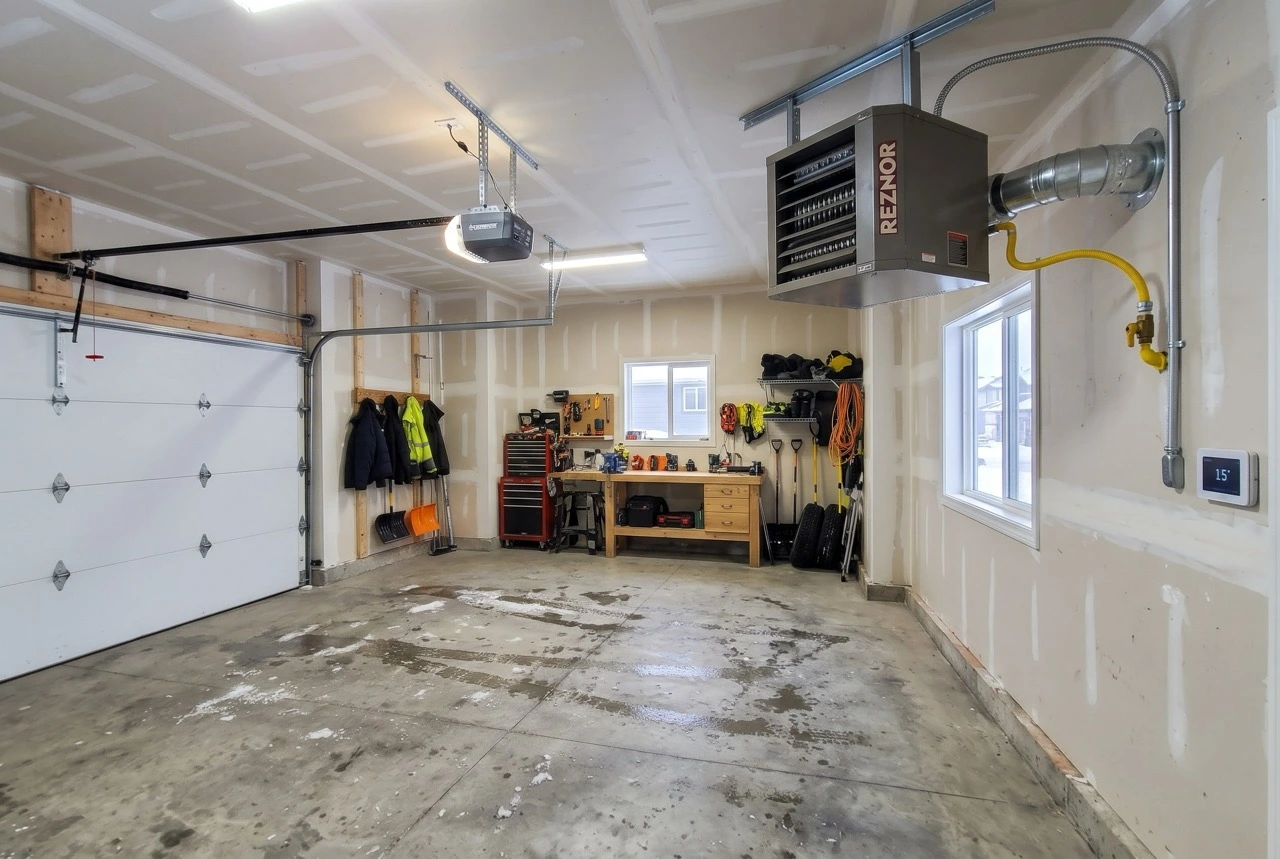
The Usual Choice: A Gas Unit Heater
For an attached garage on a home that already has natural gas, the usual answer is a gas unit heater. It's a compact box that hangs from the ceiling in a corner, burns natural gas, and uses a fan to blow warm air across the garage.
Two things make it the default in Alberta:
- Running cost. Natural gas is the main heating fuel in Alberta homes. Per unit of heat, it usually costs far less to run than electric heat, and that adds up over a five or six month heating season.
- It fits a normal garage. These heaters work with standard 8 to 10 foot ceilings, warm the space quickly, and stay out of the way.
Heater output is measured in BTUs. Most home garage units fall somewhere between 30,000 and 60,000 BTUs. The right size for yours depends on the garage's size, insulation, ceiling height, and how warm you want to keep it.
Your Three Options
| Gas unit heater | Gas infrared tube heater | Electric 240V heater | |
|---|---|---|---|
| Best for | Most attached garages with gas service | Tall garages and shops, roughly 12 ft ceilings or higher | Garages without gas, detached garages, occasional use |
| How it heats | Warms the air | Warms the floor, vehicles and people directly | Warms the air |
| After the door opens | Loses heat quickly, but warms back up fast | Feels comfortable again sooner, since surfaces stay warm | Loses heat quickly |
| Running cost | Low | Low | Highest |
| Trades involved | Gas fitter and electrician | Gas fitter and electrician | Electrician |
Infrared tube heaters are a good fit for a tall garage or a shop where the overhead door opens often. They warm surfaces instead of air, so the space feels comfortable again soon after the door closes. They cost more up front and need a high ceiling, so you don't see them often in standard home garages.
Electric heaters cost the least to buy and install, but the most to run. They make sense in a few specific situations, covered below.
What a Gas Heater Install Involves
A gas garage heater takes two trades. Knowing who does what saves a lot of back-and-forth.
The gas fitter handles:
- Running a gas line from your home's existing gas supply to the heater
- Venting the exhaust. Most newer heaters use a small fan to push exhaust out through a pipe in the side wall. The vent outlet has to stay clear of windows, doors, air intakes and the gas meter, and sit above where snow usually piles up
- The gas permit and gas inspection
- Testing the heater when it's started up
The electrician handles:
- Power for the heater. Gas heaters still need electricity to run the fan, the igniter and the controls, so they need a proper 120-volt power connection near where they're mounted
- Wiring the wall thermostat
- The electrical permit for any new circuit
- For detached garages, bringing enough power out to the building if it doesn't already have it
On an attached garage with a short gas line, the gas work is often done in a day. Make sure both trades know about each other before work starts, so the power is ready when the heater goes up.
Attached or Detached: Why It Matters
Airdrie has plenty of both: attached front garages, and detached garages off the back lane in laned communities. The type you have changes the job more than anything else.
Attached garages are the simpler case. Gas and power both come from the house, the runs are short, and the work can be done any time of year.
Detached garages are where the cost and complexity show up. Getting gas out to a detached garage usually means digging a trench across the yard for a buried gas line, and that needs unfrozen ground. In practice, it's spring-to-fall work. If you have a detached garage with no gas service and it's already winter, a gas heater is likely a project for next season.
Before any digging, a locate request has to go in through Utility Safety Partners at least three full working days ahead. That marks the registered utility lines on your property. Lines you own, such as an existing line running to the garage, aren't covered and need a private locator.
Power is the other half. Many detached garages were built with a small power line meant for a few lights and a door opener. A heater, plus the extra outlets and lighting people usually want once the garage is warm, can mean upgrading that line or adding a subpanel, a small breaker panel inside the garage.
When Electric Makes Sense
Electric isn't the usual choice in Alberta, but it's the right one when:
- Gas can't practically reach the garage, such as a detached garage where trenching isn't possible or isn't worth the cost
- It's mid-winter and you need heat now, not after the ground thaws
- You only heat the garage now and then, such as for weekend projects, so the higher running cost stays small
- The garage is small and well insulated
A proper electric garage heater runs on 240 volts and needs its own dedicated circuit. A 5,000-watt heater draws about 21 amps and a 7,500-watt heater about 31 amps. Before you buy one, confirm your electrical panel has the space and capacity for it. This matters even more if there's already an EV charger in the garage or you're planning one. Both draw a lot of power and should be planned together.
A small plug-in heater on a regular outlet is fine for warming up while you work. It won't keep a double garage warm through an Alberta cold snap.
What It Costs
Published 2026 pricing from Calgary-area contractors varies widely:
- Electric 240V heater: roughly $800 to $1,500 installed, including the heater and a dedicated circuit
- Gas unit heater: about $1,500 to $6,500 installed
For gas, the biggest factor is distance. A heater mounted close to where gas and power already reach the garage costs far less than one that needs long runs. A detached garage with no gas service lands at the top of the range because of the trenching. Venting and the amount of electrical work also move the price.
Ask for quotes that spell out exactly what's included on both the gas and electrical side, so you're comparing the same job.
Where to Mount It
- High enough to clear the overhead door tracks, the opener rail, and anything parked or lifted below it
- Aimed along the longest cold stretch of the garage, not straight at the vehicle
- With the clearances from walls, ceiling and anything that can burn that are listed in the heater's manual
- With the thermostat on an inside wall at about chest height, away from the heater's airflow and the overhead door, so it reads the room instead of the heater
Living With a Heated Garage
- Plan for meltwater. Snow and road salt will melt off your vehicle onto the floor. A floor drain, garage mats or a squeegee keeps it under control.
- You don't need it warm all the time. Many people keep the garage just above freezing and turn the thermostat up when they're working out there.
- Check your carbon monoxide alarms. With a gas appliance in an attached garage, make sure the CO alarms in the house are working.
Before You Get Quotes
- Is the garage attached or detached?
- Does the house have natural gas, and roughly how far is the gas meter from the garage?
- How big is the garage, and how high is the ceiling?
- Are the walls, ceiling and overhead door insulated?
- Does your electrical panel have open breaker spaces? (Open the panel door to look, but don't remove the inner cover.)
- Do you want it just above freezing, or warm enough to work in?
- Is there an EV charger in the garage now, or planned?
Frequently Asked Questions
What is the most common type of garage heater in Alberta?
For attached garages on homes with natural gas, a ceiling-mounted gas unit heater is the most common choice. It's compact, heats quickly, and costs much less to run than electric heat.
Does a gas garage heater need electricity?
Yes. Gas unit heaters need a 120-volt power connection to run the fan, igniter and controls, and the thermostat needs to be wired in. A gas fitter handles the gas line and venting. An electrician handles the power and thermostat wiring.
Can I run a gas line to a detached garage in winter?
It's difficult. A gas line to a detached garage is usually buried in a trench, which needs unfrozen ground, so the work is generally done between spring and fall. If you need heat before then, electric is the common alternative.
Do I need a permit to install a garage heater in Airdrie?
Yes. Gas work needs a gas permit, pulled by a licensed gas fitter. Any new electrical circuit needs an electrical permit and inspection. In Airdrie, the City issues electrical permits to homeowners doing the work on a house they own and live in, or to approved electrical contractors.
Is an electric garage heater worth it?
It can be, if gas isn't available, the garage is small and well insulated, or you only heat it now and then. For a garage heated all winter, gas is usually far cheaper to run.
Get the Electrical Side Ready
Whichever heater you choose, it needs power. Zap Electric Corp handles the electrical side of garage heater installs in Airdrie and the Calgary area. That includes power and thermostat wiring for gas heaters, dedicated 240V circuits for electric heaters, and panel or subpanel upgrades for garages that need more capacity.
Contact Zap Electric Corp for a free estimate, or call (587) 228-7807.